Saturday, January 14, 2012

Game Mechanic: Tile Placement

If there is one mechanic above all others that I am immediately drawn to its tile placement.  I enjoy starting with nothing at all, or just a blank board, and seeing what I have created at the end of the game. In some tile placement games, like Carcassonne the City, you end with a beautiful visual of a completed city.  It's fun to watch the reactions of other players at their creation.  I see the pleased look on their faces as they look at what they and the other players have designed. 


Hallmarks of Tile Placement Games

Tiles

Tiles can be used to score points, extend the playing area or map, or change the board.  There are many shapes and sizes for tiles. Squares, rectangles and hexes are common. 


Tile Placement

These tiles are placed under specific rules for that game.  In the game dominoes, for example, the bones are placed so that matching numeric values touch.  In the game Blokus players must place the Tetris like tiles so that they don't lie adjacent to other tiles, but touch the corner of another piece already on the board.  In some games the orientation of the tile is very important.  In the game Cable Car tiles must be placed so that are the buildings pictured on the tile are facing the same way.

Who places the tile, and how the tile is used, differes from game to game.  Most games have the current player placing and using the tile.  Others, such as Cable Car, allow multiple players to use the same tile.  Once these tiles are placed they usually are not moved for the rest of the game.  Of course there are always expections to these rules!


Wednesday, January 11, 2012

Thank You AEG!

Tonight I am want to publicly thank a board game company for going above and beyond in customer service.  The story that I will shortly tell, is not uncommon with board game companies and is yet another reason gaming is such a great hobby.

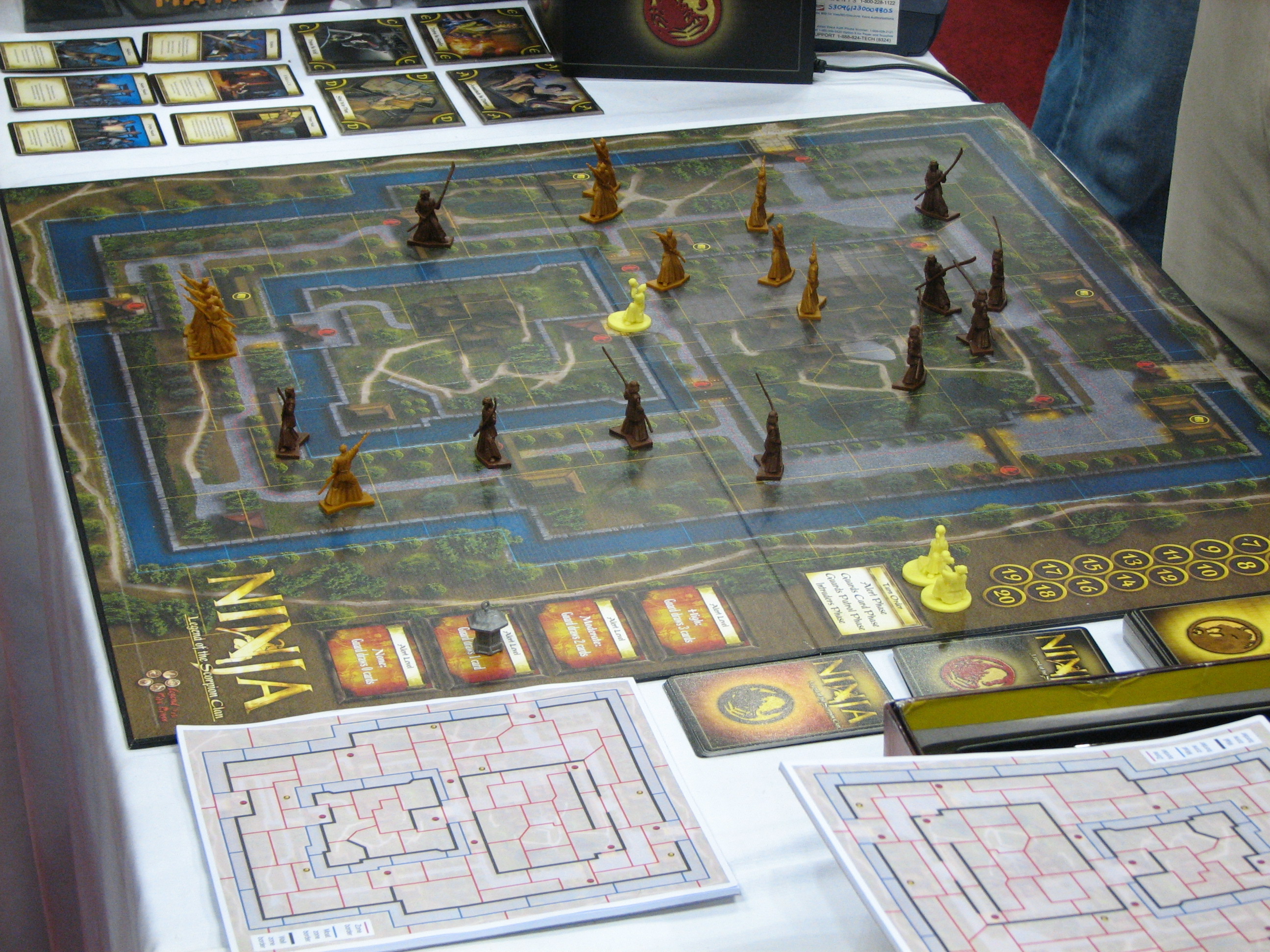
Shortly before Christmas I bought a newer game at a game store for my husband as a gift.  That was the game: Ninja: Legend of the Scorpion Clan.  I have been excited about this game for awhile now and was even more excited that I was able to find it at a game store.  Unfortunately,  they didn't give me the game I had taken off the shelf and instead handed over one that had been sitting under a mountain of other games.


The idea was that they kept one with the price on the shelves but then others in back.  This way they could save shelf space.  Which is a great idea, but can lead to damage as I discovered.  When I got the game home I noticed that the side of the box had been pushed in, and was slightly worried but not too concerned, yet. 


When we opened the box we were relieved that the cards and pieces hadn't been damaged.  That was until we saw the board.  The board took most of the damage.  To make matters worse it was the corner that was the middle of the board when opened.  The board would not lay flat, was very bent, and the laminate was starting to peel.  This, I am sure, would have gotten worse as we played the game. 

I was upset, to say the least.  I could not take the board back to the game store easily because, well, because it was almost three hours away!  I was annoyed with myself for not checking the box more carefully, and at the store for not being more careful with their merchandise. 

Luckily, my husband gave me a great solution.  He searched on Board Game Geek and saw what great customer service AEG, the publisher, had.  So I emailed them, but got a reply back that they were out for Christmas Break.  I was happy that they gave their employees some time off and did not anticipate another e-mail for to later in the new year.  On January 4th (earlier then they said they would be back) I got another email from David Trudeau from AEG's customer service.  He told me that a replacement board was on its way.  I couldn't believe it!  They sent a new board just like that.  No further questions, no asking to send them the damaged board, no hassle whatsoever.   The board arrived soon after in perfect condition and I hope to play the game soon.  I am thankful to AEG for their wonderful customer relationship and their wonderful games.  I am appreciate to them for replacing the board when I had not even bought directly from them.  This was something I hadn't expected.  I am very grateful they were willing to help.  Playing the game will be so much more enjoyable with an undamaged board.  So thank you AEG!


Tuesday, January 10, 2012

Stone Age

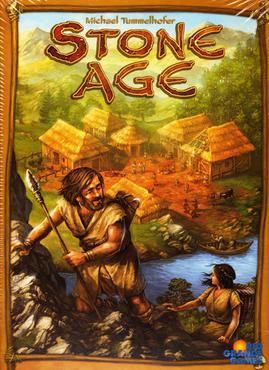
Agriculture was an important breakthrough in human history.  We no longer needed to spend all our time hunting and gathering.  We could focus on other trades, develop art and pottery, and look beyond our small family unit.  This unique period of human history is captured in the game Stone Age, a fun worker placement game.  Best of all it  works well with two to four players.
  
Components:

Stone Age is first and foremost a beautiful game.  The art on the game board is outstanding and the quality is top notch.  Even the back is decorated. To me, this just shows the pride some game publishers put into their games.

Back of Board


The wooden components that come with the game are 68 wooden resources (gold, stone, brick, and wood) and 40 wooden stone age meeples in four player colors. 

You also receive 28 hut tiles, 36 civilization cards, 1 start player figure, 7 wooden dice, and 4 player boards.


The one component that has caused some trouble is the leather dice cup, while this is thematic many people don't like it or have had trouble with the smell.  My cup never had a smell to it.  I have never used it to play the game, but it is a nice addition for people who like dice cups.  I do believe that the company has corrected this issue in reprints.


Set Up

Set up is easy due to another plus for this game.  The wonderful rulebook has a helpful two full pages of set-up directions.  Not only is this great when you first start playing the game it is also very beneficial when you haven't played for awhile and want to do a quick check to make sure you are setting up correctly.

Goal of the Game:


You win by scoring the most victory points.  Points come from building huts during the game and the civilization cards you collect throughout the game.


Game Play

There are three phases of play:
  • 1. Players place people
  • 2. Players use the actions of their placed people
  • 3. Players feed their people

Phase 1: Players Place People

Players start out with five people at the start of the game. These are your workers you place them on different sections of the board to gather resources, build huts and so forth. 

The start player begins and must place one or more of their people on one place of the board.  The person must be placed in one of the rings .  If there are no open rings people can not be placed.  A player may also not add more people to an area they already have people. 
Once the first player has placed their people the next player in clockwise order places theirs.  This continues until all players have placed.

There are ten different areas where players are able to place people. All are beneficial but you may be blocked from an area you really want.  The only area that has no limit is hunting and players may place as many people there as they wish.

Phase Two:  Players use the actions of their placed people

Again, the start player begins.  He uses all his placed people and when finished the next player in clockwise order may use his people.  You can use your people in any order.  Sometimes the order is crucial so one does not want to rush through phase two.

Each area offers a unique resource or scoring opportunity.  I'll briefly explain each area.

Tool Maker: You may take one new tool and place it on your player board.  You start with a one tool until you have three then you may take a two tool all the way up to a four tool.  Tools are used once per round to add to a die roll.  Once used it is filled to show that it can not be used again.

Field:  If you place your figure here you may move your marker up one on the food track increasing your food production.  Which means you have to pay one less food in the third phase.

Hunt:  Here is where the dice rolling begins!  For each person you have placed in the hunt area you take one die and roll it (use your dice cup if you wish!).  Count up your dice and divide by two.  You get that much food from the supply.  Use a tool if you need to here!

Forest, clay pit, Quarry, & River:  Get those dice out again and start rolling!  For each person placed in the area the player roles that may dice.  You can use a tool again as well.  Wood is the easiest to harvest so players divide their number by three.  Brick is by four, stone five, and gold, the hardest, by six.  If you have trouble remembering your player board has a handy reminder.


Civilization Cards: Civilization cards serve multiple purposes.  They give you resources, immediate victory points, tools, food, or even an additional food production.  But they are also saved for the end of the game to give victory points.  Only one person can be placed on each card.  The player must pay the number of any type of resource to acquire the card.  If you do not have enough to pay you do not have to take the card.  You may even decide to not take the card even if you have enough resources. 


Buildings: Building huts earns a player points during the game.  You must pay the resources indicated on the hut card.  Then you move your scoring marker up the indicated number of points.  You place the hunt on your player board.  Some huts list resources - two brick, one wood that must be paid.  Some list the resource symbol and a number.  This means you may pay as resource but must pay the indicated number.  You source points based on the resource you paid: 3 for wood, 4 for brick, five for stone, and six for gold.  Some show a number range such as 1-6 and the resource symbol.  These mean use must pay any resource and you may pay up to six.  You score points based on how many and of what type you pay. 


Hut:  The last available space makes me blush a little.  I said that you start with five people but can get more during the game.  Well here is where the magic happens.  You place two people at the hut and then take one person from the supply that you use during the next round.


Phase Three: Feed Your People!

At the end of each round players must feed their people.  Each player pays one food per person.  You start the game with twelve food so the first few rounds are easy.  For each number on the food track you may pay one food less.  I've been able to get my food production up in some games so that I didn't have to worry about feeding my people at all, which is just pure satisfaction.  If you do not have enough food you may pay one resource for each missing food instead.  The idea being that you people traded their resources for food.  If you can not pay, your going to lose 10 points for each food not paid.

New Round

Now that start player hands the marker to his neighbor to the left.  The civilization cards are moved to the left and filled in, and any new hut is flipped up to start the new round.  Repeat until end conditions are met.

Start Player Token
Game End

The game ends in one of two ways.  If there are not enough civilization cards to refill the display the game ends.  Also if at least one building stack is empty at the end of a round the game ends.  Players still must feed their people at the end of the round and then proceed to scoring.

Scoring

Scoring is probably the most complicated part of Stone Age and luckily it is not very complicated.

Players should sort their civilization cards into piles with green and brown backgrounds.  I like to start with green background cards.  You count the number of different civilization cards that you have.  There is writing, healing, pottery, art, time, transport, weaving and music.  Then you times that number by itself.  So if you have three different background you times 3x3 and get 9.  If you have duplicates they count for one point extra each.

Next score your brown cards.  For the ones showing the food production symbol multiply the number of farmers on the card by your food production number for your score.  Do this for each card you have collected.  For the cards showing tools score you number of tools times the number of workers for each card.  Then score the hut by the number of workers and the shamans by how many people you have.

Winner is whomever had the most points!

Changes for 2-3 Players

If you have two players for the game there are some changes.  First, at the tool maker, hut,and field only two may be filled each round and one must be left empty.  For three players only two may place people at the forest, clay pit, quarry and river.  This is the rule even if there are spots remaining.  In a two player game only one person may place at each of these spots.


My Thoughts


As my husband and I were playing this game the other night he mentioned that "this is a game that I will always have in my collection, others will come and go, but Stone Age is definitely one to hold on to for a long time."  I had to laugh to myself since he didn't know I was planning on reviewing Stone Age next and he summed up by feelings exactly.

Stone Age is a good game, period.  It easy to teach and easy to learn.  It scales so well for many different numbers of players, and is probably one of the best two player worker placement games out there.  Every time I play I think I have the strategy down to win something happens during the game to change it.  Once I focused on trying to get all the civilization cards, but lost because of not building enough huts, other times I try the hut route and lose because I can't get the resources. (Umm, I must lose this game a lot come to think of it!)  But again, win or lose I always have fun. 

Quick Stats:

Designer:  Bernd Brunnhofer
Artists: Michael Menzel
Publisher: Rio Grande Games, 999 Games, Hans im Glük
Number of Players: 2-4
Play Time: 60-90 minutes

Don't Forget to Feed Your People!

Saturday, January 7, 2012

Game Mechanic: Worker Placement

Choices, choices, choices...but what's the best choice to make?  Maybe I should gather some wood today, or perhaps I should go buy some cattle, but, I can't forget about feeding my hungry people, oh what choice to take?

I've decided to start talking about game mechanics with worker placement. Some of my earliest hobby games involved this mechanic and surprisingly enough, it works well in many two player games.  I enjoy the competition of worker placement games and the sense of accomplishment that comes at the end of a game of gathering resources to build something bigger.

Hallmarks of Worker Placement

Workers

As the name suggests, players are given a specific number of workers.  You may have farmers, dock workers, cavemen, painters, and so forth.  Any type of worker that fulfils the theme could be used.  These workers are limited in number.  Some games allow you to gain more workers, others only give a certain amount for the entire game.


Pillars of the Earth Workers

 Limited Actions with Competition

Using your workers you will choose from a limited number of action spaces or cards.  You and your opponents are in fierce competition for these spaces since all are important in order to win the game.  Using your workers you must optimize your actions and block your opponents from doing certain actions.
Another type of worker placement may only allow you limited number of turns but give you more options.  In these games you must choose wisely since time is limited.

 
Location Choices in Agricola
Resources

Your workers are gathering resources.  These resources can vary depending on the theme.  For example in the game Fresco you are a painter restoring a Fresco and your workers are gathering painting supplies.  In the game Agricola you are a farmer and you may be gathering wheat, plowing your field or building fences for your pasture.  Sometimes you must gather multiple resources that are combined to build something else later. 
Wheat, brick, wood and other resources

Player Order is Important

Since you have a limited number of choices or turns player order becomes a crucial part of worker placement games.  You don't want to always be blocked from an important action.  Also you want to make sure your opponent doesn't get the resource they desperately need.  So going first becomes very important.  In some games you may even be forced to use a valuable action to in order to take the first player role.

Fresco Painters

Wednesday, January 4, 2012

Next Up: Game Mechanics

I can't believe that I have already covered most of the game types.  I know, I know there are definitely more game types I could cover, namely war games.  But honestly, I don't know that much about war games.  I may come back to it someday but for now I am going to move on to game mechanics.

What are game mechanics?  Umm, that's a tough question.  Basically, game mechanics are the the the different rules and ways to play a game.   You may be familiar with the roll and move mechanic.  This is how you play Sorry! and Monopoly.  Roll the dice and move that number of spaces.  But there many, many, many more.  I think I'll be at this for awhile but I'm looking forward to it.  As with types I will first discuss the mechanic and then review a game.  And, as much as possible I will focus on two player games!

Tuesday, January 3, 2012

Wallamoppi


Tonight I will review my first real game built for two: Wallamoppi. Wallamoppi is a stacking dexterity game. It reminds me a lot of Jenga, but this are a few twists that set it above that well known game. 

Components

I love when games use the box as part of the game.  It rarely happens and it doesn't always guarantee a good game, but it does make it interesting.  Wallamoppi comes in a wooden box that is also the timer for the game.   The second part of the timer is a black marble.  Luckily it includes a replacement marble in case you lose the first one.

The next components are the 36 wooden kiwi disks.  They come and light and darks shades; one color per player.  You also receive a disk bag that can be used for storing the disks and to set up the game.


Game Play

There are two steps of Wallamoppi:  building the wall and building the tower.  You are not timed as you build the wall.  As you build the tower you can lose if you don't place your disk in time or if you knock the tower over.

Step 1: Building the Wall

To start the game players need to set up the wall.  You place all the kiwi disks in the bag and decide which color each player will play.  Each player receives one disk of that color.  Without looking the person playing the dark color draws a disk out of the bag and lays it on the table.  Next, the player playing the lighter color draws and places the a disk next to the first.  This continues until all the disks in the bag have been drawn and placed to build the wall.


Players will build the wall so that the first row has eight disks, the second row has seven, the third row six, and so forth until they end with one disk on top.  It doesn't matter which disk a player draws, they must place that disk.  When players place the disks it needs to be next two an already placed disk or centered on top of two disks.

After the last disk is placed the player using the dark color places the disk set aside at the beginning of the game on top of the tower.  The second player playing does their same with their last disk. 

Step Two: Building the Tower

Now that the wall has been built player can start building the Tower.  This is the dexterity part of the game. Like Jenga you need to remove pieces and place them on top to form a tower.  Unlike Jenga you have the added pressure of being timed!

The person playing the light color will be the timer first.  They start the timer by dropping the marble in the hole at the top of the box.  The player playing the dark color must remove one disk, using only one hand, of his or her color and stack it on top of the tower. 

But that's not all!  They then need to catch the marble before it drops to the hole at the end of the chute.  If they are successful the light player takes his turn at removing and placing the the and the dark player drops the marble. 

This continues until one player either knocks the tower over (even if just one disk from the tower falls) or they don't catch the marble before it drops.  The winner is the person who last placed a disk, in time, without knocking over the tower.

My Thoughts

One must have a steady hand and a quick mind to master the game of Wallamoppi. Not my best skills, but I like the challenge presented by this game.  You must be quick, you can't second guess, and you can't forget to catch that marble.  Which I have done, more than once!  But that makes this a fun, fast-paced dexterity game that I rate highly. 

Another plus for this game are the components themselves.  Each and every components is high quality.  The disks have a great feel to them and I love the Kiwi that is on each disk.  The marble chute is awesome!  I love how the marble rolls down the chute.  It's not much fun when you racing the marble.  When I'm the timer I love watching the marble take its journey.  One component that I don't like is the bag but that is a minor quibble.

I also like the fact that you can teach, set up and play this game in less then 10 minutes.  I don't think Jenga is even that short!  Making Wallamoppi another easy to learn, but hard to master game.

Since this is only a two player game it definitely works well with two players, which is a must for games I play.


Quick Stats:

Designers:  Garrett J. Donner, Michael S. Steer
Artists:  John Kovalic, Cathleen Quin-Kinney
Publisher: Out of the Box
Number of Players: Two

Monday, January 2, 2012

Game Type: Dexterity Games

So far I have talked about games that challenge you only mentally, but being a somewhat active person I also like games that will challenge me physically as well.  No, I'm not talking about basketball or baseball here, I'll still stay in the realm of boardgames and turn to Dexterity Games.

We have all at one time or another probably played some of the tried and true dexterity games out there: Twister, Operation, Jenga, or pick up sticks.  Those games you love to hate because just as you go for that last block in Jenga, certain you can leave you opponent with an impossible task, you instead find yourself sitting in the middle of a ruined tower.  Ah, the joy and agony, the games we love and hate at the same time, our next game type: dexterity games.


Hallmarks of Dexterity Games

The most important hallmark of dexterity games is that they will challenge the players both physically and mentally.  This usually happens at the same time.  They will challenge your reflexes, your coordination, your fine motor skills, and of course your mind. 

For example look at the game Sorry! Sliders.  In this game you are using your physical skills of hand /eye coordination as you slide your pawns on the board.  Then your challenge your mind as your think of a bit of strategy and decide where to aim and how to block your opponents.   We also can't forget the basic sometimes rusty adding and subtracting skills as you tally our score.  Sorry! Sliders, challenges the player both physically and mentally. 


After the combination of physical and mental challenges there isn't another must for dexterity games.  At least in my opinion.  There are a lot of dexterity games available with many similarities in style, components, and game play.  Yet these can vary greatly and as long as you are challenged both physically and mentally, you are playing a dexterity game.

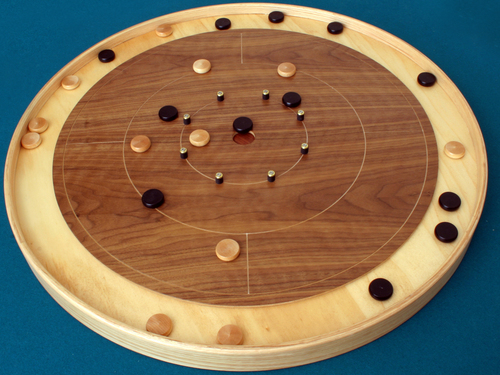
I will add that many dexterity games, like abstract games, tend to be works of art.  I have known people to even hang their crokinole boards as the wall as art when they are in aren't in play.


I wanted to leave this blog with some beautiful pictures of palm puzzles I found at the website: project b.  These vintage puzzles have an amazing history all their own and I encourage you to wander over to the website and spend some quality browsing time.