Thursday, June 7, 2012

Roll Through the Ages

Building a civilization with the roll of a die in 30 minutes or less is the theme behind this great game.  Make use of workers to help build more cities to expand your empire. Collect and trade goods to discover such developments as irrigation and religion.  Create wondrous monuments like the Hanging Gardens of the Great Wall of China.  But don't forget to feed your people are bad things could happen.  And always be prepared for that inevitable disaster that may come your way.


Object of the Game

Become the most advanced and prestigious civilization by accumulating cities, monuments, and developments.  Avoid the devastation of disasters.  And you will score the most points and win the game.


Components / Set-up

This is a little game with a lot packed into it.  You start with the four beautiful wooden peg boards that are used for keeping track of your goods, and of course the food for your people.  Four of these are included in the game.  To go along with the pegboard there are also 24 wooden pegs.

Players take one pegboard and six pegs.  They set their food to three on the pegboard and the five good pegs to zero.


Each player will also need one of the score sheets and a pencil.  The start player is chosen randomly and they are given three of the seven wooden dice.  This player should put a star on their score sheet that will help determine who takes the last turn of the game. 

Game Play

The game plays over a series of rounds.  Each round the players each take a turn.  After each player has taken their turn a new round begins.

A player may do all of the following steps their round, if possible.

1.  Roll dice and collect goods and food
2.  Feed cities and resolve disasters
3.  Build cities and / or monuments
4.  Buy no more than one development
5.  Discard goods in excess of six and pass the dice

1.  Roll dice and collect goods and food

Players roll one die for each city they posses.  After rolling any dice that have a skull are set aside.  The remaining dice may be kept or re-rolled.  After the re-roll, skull dice are again set aside.  Now the player may re-roll any of the dice, including the ones kept from the first roll, that do not have skulls.  After the third roll, the results must be kept.


Collect Goods:  Players add goods, one at a time, to any goods that they may already have by moving the peg one position to the right for each good, starting from the bottom row, Wood.  Then they proceed upwards to Stone, Pottery, Cloth, and Spearheads. If the player earned more than 5 goods this turn, add the additional goods, starting at the bottom row and proceeding upwards as before.

Collect Food:  Advance your food peg 1 position for each food symbol on your food dice.  Two food or two workers are collected on the dice marked with the wheat / people symbol.  If you don't have room on the pegboard you don't collect extra food.


2.  Feed Cities and Resolve Disasters

Feed Cities:  Each city (each die rolled) requires the player to pay one food.  You must subtract one food, on the pegboard, for each city in your possession.  If you don't have enough food, each city that is not fed suffers famine and costs you one point per unfed city.

Tracking Lost Points:  Check off a box in the Disasters section of your score sheet for each point lost.  These points will be tallied, and subtracted from your score, at the end of the game.

Resolve Disasters:  If a player's dice show more than 1 skull, a Disaster will occur.  Two Skulls result in a Drought.  Droughts cause you to lose 2 points.  If you have Irrigation, you are not affected.  3 skulls cause Pestilence and you opponents to lose 3 points.   If they have Medicine they are not affected.  4 skulls result in Invasion and you lose 4 points.  If you have completed the Great Wall monument you are not affected. 5+ skulls result in Revolt and you lose all your goods, including the ones just collected.  If you have Religion, instead of losing all your goods, your opponents lose all their goods.  If they also have Religion they are not affected.


3.  Build Cities and / or Monuments

For each worker shown on your dice check off a box in a city or a monument.  Once you've checked off all the boxes in a city it is built.  Circle the die icon to remind you.  The next turn you will begin with one more die.  You can build up to four new cities (total 7) giving you a maximum of 7 dice per turn. 


If you the first player to check off all the boxes for a given monument, circle the larger number of points next to the monument.  Instruct all the other players to cross off this larger value - any players who later complete the monument will only get the smaller value.  These points will be tallied at the end of the game.  Incomplete monuments are worth nothing at the end of the game.


4.  Buy a Development

A player may purchase one development per turn by spending coins and goods equal to or above the cost shown on the score sheet.  If you spend a type of goods, you must spend all of that type of goods, for the value listed under its peg, before you shift it to its leftmost position.  No change is given, so any excess value is lost.  Each player may purchase each once.  When you buy the development, place a check mark next to it on your score sheet and circle the points listed next to it.  These points are tallied at the end of the game.

5.  Discard Goods in Excess of 6 and pass the Dice

You may only keep a total of 6 goods.  Each icon on the pegboard is considered one good. 

If you have more than six, "discard" excess goods of your choice by moving your pegs to the left on the tracks.

For example, if you had 5 wood and 2 stone (a total of 7 goods) you must discard 1 good.  You may discard either 1 stone or 1 wood by moving the respective peg one icon to the left.  You only need to discard goods at the end of your turn.  After discarding goods, pass the dice to the player on your left.  If you purchase the Caravans development then you will not need to discard any goods.

Game End

The game is over at the end of a round when:  One player buys his 5th development or each monument has been built at least once by any of the players in the game.

Play continues until all players have had an equal number of turns.  The last player should be the player to the right of the start player.  Players should now tally up their scores. Points are added for every completed monument and for every development.  Players who bought architecture should add 1 point for every monument.  Players who built empire should add one point for every city they have.  Players subtract 1 point for every box checked in the Disasters section of their score sheet.  All of this is added and subtracted to determine the players' final score.


The player who has the most points wins the game.  If there is a tie the player with the most remaining goods is the winner.

Rules for 3 player Games

The normal rules are used, but before playing the players should cross off the Hanging Gardens as it is not used in the three player game.

Rules for 2 Player Games

The normal rues are used, but before playing the players should cross off the Temple and the Great Pyramid. These monuments are not used in the two player game.


My Thoughts

The first thing that your notice about this game, are the quality components.  The dice, the peg boards, and the pegs are made of a quality wood that will stand up to years of use.  You only get one pad of score sheets that will eventually go away.  But there is a downloadable expansion that you can print-out.  I have also seen someone laminate a few of the sheets so you can reuse them over and over.  This is a great idea and certainly one I will be copying soon.


Game play reminds me of Yahtzee, but in a good way.  It's quick, light, easy to play and easy to learn.  This makes the game accessible to non-gamers, younger players, and hobby gamers.  The dice are random and thus the game involves a lot of luck.  Careful planning, allocation of resources, wise use of bonuses, and avoidance of disasters (if possible) had a fair amount of strategy.  These elements appeal to hobby gamers looking for a filler game, week night game or a game to play with the family. 


The game may be short but at the end of the game, as you look at your score sheet and peg board you really do feel like you have built a mini-civilization.  Every time Roll Through the Ages comes to the table there is always a smile on everyone's face.  It's just fun rolling dice, agonizing over the skulls, and then realizing you rolled three skulls so the disaster affects your opponents and not you (yeah!).  Plus the skulls still give you two goods so they aren't horrible. 


The game also plays well as a solitaire.  This is rarely a selling point for me since my husband is always willing to play games but during the summer when I have a lot more free time it is nice to pull out a game, challenge myself, and try to beat my best score.  There is a lot of game packed into this little box and I recommend it to just about anyone.


Quick Stats

Designer:  Matt Leacok
Artist: Marko Fiedler, Monte Moore, Paul Niemeyer, Claus Stephan
Players: 1-4
Publishers:  Gen-X Games, Gryphon Games, Korea Boardgames, New Games Order, LLC, Pegasus Spiele, Quined White Goblin Games, Swan Panasia Co., Ltd., White Goblin Games
Time: 30 Min
Ages: 8 and up
Mechanics: Dice Rolling, Push Your Luck, Paper and Pencil


Photo Credits:(from www.boardgamegeek.com in order of appearance) my eye (earache),surmik(surmik), surmik(surmik), Ender Wiggins (EndersGame), Ender Wiggins (EndersGame), Henk Rolleman (henk.rolleman), Henk Rolleman (henk.rolleman), Russell Howell (Left for BGG) (badgeguy), Laszlo Molnar (lacxox)

Please note that I didn't take the photos in the blog, I thank all the wonderful gamers out there who care so much about board games that they take such wonderful pictures.

Wednesday, June 6, 2012

Origins

Since getting into hobby of board gaming my husband and I have traveled to Columbus Ohio a few times to visit Origins.  We usually make it a day trip - head out early, cruise the dealer hall, have dinner at North Market, and drive home.  It makes for a long day, but we have always enjoyed it.  This year we decided we wouldn't be going because of the date change.  Both of us would need to take a personal day and it would be too close to the end of school.

But after debating between a trip to Ohio and a trip to GenCon, Origins won out this year.  We both took a personal day and heading to Ohio early Thursday morning.  With the option of having more time we would be able to see more things, meet more people, and try out more demos.  I also brought along my copy of the Battle of Red Cliffs hoping to test it out with a few people.

After registering (yeah Educator's Hall Pass for 1/2 price) we headed into the dealer hall.  I had honestly expected a sparse year but was pleasantly surprised to find at dealer hall nearly full.  There have been past years with more dealers.  This year seemed to have way more room for demoing.  Game Salute had a huge area displaying many great Kickstarter success stories and hopefuls.  Rio Grande also had is usual large area and lots of Catan tables.  I was so excited to play test "Mice and Mystics" with Colby Dutch from Plaid Hat Games.  I am very excited about this game and hey we got to play with Colby.  The game was a lot of fun even if I was the last mouse standing left to fend off Brodie, the cat, a centipede and other assorted bugs.  We went down in a blaze of glory!


We spent most of the rest of Friday just walking the dealer hall and picking up a few games.  I tried out my mad caveman curling skills and picked up "Defenders of the Realm" with painted miniatures for 40% off the show special.  We also picked up the next most have from the convention, the new Dominion base cards.  Finally the money won't all look the same!


We found a hotel room and then ate a late lunch at the North Market not far from the convention center.  I certainly recommend this location for a great meal.

There is so much variety and all wonderfully prepared food.  And, in case, like me, you didn't know there is a second floor with seating.  This information would have been quite helpful to know two years ago!

After the dealer hall closed we walked down to the waterfront to check out the Art Festival.  There were some pretty amazing pieces of art there and I enjoyed walking through the displays.  What really amazed me as well was how nice people were, I accidentally walked out in front of the bike policeman and he actually apologized to me!   And everyone was like that. The people of Columbus are great.

I had planned on trying some open gaming Friday night but since I had been up since 3:30 and still felt like I was fighting off a cold we cut the evening short and decided to get up early the next day.  I never did get a chance to play test the Battle of Red Cliffs with anyone regrettably.

Richard Borg from Dan Edelen at Bordgamegeek.com
Friday we actually got to the convention before the dealer hall opened.  That was a first.  We planned on demoing a few more games and focused on Samurai Battles. We were hoping to see Richard Borg and play a game with him.  My husband talked to one of the workers at the booth about the "Art of Tactics" game play while I struck up a conversation with an older gentleman about the game and my enjoyment of Memoir '44 and other games by Richard Borg.  He surprised me by introducing himself as Roy Grider, and explained that he, Richard and another friend actually started the game in his basement.  He does the historical research and miniatures while Richard designs the board game aspects and does the marketing.


He then introduced me to Richard Borg and we talked for quite awhile about their history together and all the expansion they want to have for Memoir '44 (in the works to about 2014 right now) and new games they are thinking of trying.  Both of them were so enthusiastic and so friendly.  I felt like I was talking with a couple of old friends.  My husband soon joined us and we must have talked for about an hour when we finally purchased Samurai Battles and Richard Borg signed the game box for us.  I can tell you from our conversation that this is a very well researched game and the game play really does try to mimic the actual events of the Samurai battles.  Now my husband will have lots of fun putting all the miniatures together.

The rest of the afternoon was spent trying out some more games, picking up a few, scoring the last expansion of Heroscape Dungeons and Dragons we didn't have and then some amazing ice cream from Jeni's at the North Market.  I happily say that I was able to win as the good guys in "Revolver" from Sronghold games, one of the other new games we purchased.

Origins was great and I left feeling good about the board gaming industry.  There are a lot of amazing people: Richard Borg, Colby Dauch, the folks at Game Salute and Myriad Games, and so many others.  I'm glad to be a part of it.

Monday, May 28, 2012

Coming Soon: The Battle of Red Cliffs


A few months ago I wrote of review of Tien Zi Que.  It is one of my favorite card games and I was honored when the designer commented on my review.  Then, to my further amazement he asked me to play test a game he had been designing in the same line of Tien Zi Que and his game the Battle of Red Cliffs.

Of course I took him up on the offer and soon had the prototype for Red Cliffs in my hands.  With the help of friends and family we played the game and tried to offer our best praise and criticism (though there wasn't much of this).  It has been amazing to be a part of this process and I am excited about seeing this game published.


Goal of the Game:

Battle of Red Cliffs is a card variant of mahjong. Like Mahjong, each game of Red Cliffs takes several rounds of play.

What is unique about the Battle of Red Cliffs is that during the round, players collect sets of cards and keep one card from each set.  These are used for end of round scoring. When one player has five or six score cards, the round continues until the last player finishes his/her turn. Each player adds victory points to the score board based on the combinations of the score cards.  Play then continues to the next round. The game ends when one player, or a team, reaches a certain Rank level.  The player, or the team, with highest score wins the game.
Components:

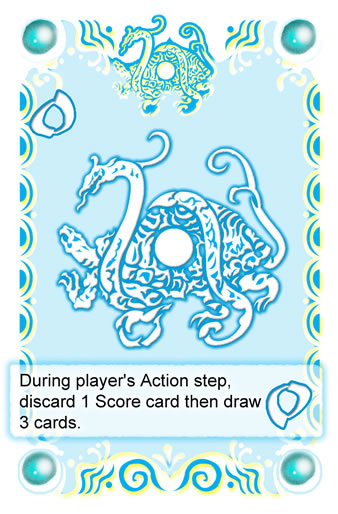
Because I am play testing this game I can't comment on exactly what the final version will look or feel like.  I am excited because I like the anime and Asian style of the artwork.  Fans of he older version of The Battle of Red Cliffs will recognize the artwork as being very similar is design.  There are a lot of cards (117), a score board and more coming with this game.

 
Number Cards
- Zero- 16 total (4 Red, 4 Blue, 4 Green, and 4 White)
- Numbers 1 to 9 -  63 total  (18 Red, 18 Blue, 18 Green, and 9 White)
Special Cards    

- Beauties -  28 total (8 Red, 8 Blue, 8 Green, and 4 White)  The beauties are called warrior, dancer, maiden, and damsel.

 - TZQ - 9 total (These are the black cards)

- Event - 1

There are also 9 Command cards that give players special abilities, 9 player aides, one score board, and 7 score tokens.

Game Setup:

Players must first choose which game type they are playing: man on man or teams.
  • Man on Man for 2 to 7 players
  • Teams of Two for  4, 6 or 8 players. (Team members must sit at least one or more seats away from one another.)
  • Teams of Three for 6 or 9 players. (Team members must sit two seats away from one another)
Next, players must place the score tokens on the Score Board accordingly.  

For Man on Man each player chooses a color and places the token on the "Level 1" space of the score board.  For teams of two each team chooses a color (red, blue, green or white) and places it on the "Level 1" space of the game board.  Or, for teams of three each team chooses a color (red, blue or green) and places the score token on the Level 1 space of the scoreboard.  The remaining tokens are placed back in the box.


Now, each player randomly takes one Command Card and one the Player Aide card for his/ her team color.  The remaining cards are removed from the game. The youngest player will be the Starting Player.

Round Setup:

For the first round of a new game, each player takes one TZQ card into his/her hand and then shuffles all remaining cards face down to form a Draw Pile. Make sure to leave extra space for three discard piles next to the draw pile. For all other rounds, each player takes one TZQ card from the Trash Pile into his/her hand.  Remember, you DO NOT shuffle cards to form a draw pile at the end of a round.
 

Now each player draws five additional cards from the draw pile into his / her hand. If an event card is drawn, draw another card.  Then, shuffle the event card back into the draw pile.  When this draw pile is depleted at any time during the game, shuffle the Trash Pile face down to form a new draw pile.  Players do not reveal their hand cards to other players, including team members.

Game Play:

The round begins with the starting player, and each player takes a turn proceeding clockwise.  During each turn, the active player takes four steps in specific order.  These steps are:
  1. Peng!
  2. Draw
  3. Actions
  4. Refill
Step 1: Peng!

Peng! is an interpretive action.  Players take two hand cards an a top card from Discard Piles B or C to create a Trips Set.  After creating the trips set, the interrupt players chooses one cards as a score card and places the two other cards in the trash pile accordingly.  The active player then continues with his are her turn.

The interpretive player may not refill their hand cards until the Refill step on their turn.  But there is no limitation of Peng! actions hat player may make per round.  Sometimes more than one player may be able to take a Peng! action. Priority goes first to the active player.  After this the player who sits closest to the active player has the priority. 

Step 2: Draw

The active player now draws one card from the draw pile and takes it into their hand.

Step 3: Actions

The active player may create 1 or 2 sets and play at least on action card.  This may be done in any order.  For example, the player may play an action card, create a set, and then play another action card.  If the active player does not create a set or play an action card they may discard 1 or 2 hand cards.

Creating a Set:  A set contains three cards.  These cards by be a straight or a trips set.  A Straight Set is three consecutive numbers.  For example 1, 2, 3 or 7, 8, 9.  1 and 9 are NOT connected and cannot be used to create a straight set.  Three different Beauties may also be used to create a set. When creating a set with three Beauties the players may choose to take one set action from one Beauty.  If they use a TZQ and two Beauties they may still only take the action from one Beauty.


A Trips Set is a set of three cards of the same card.  For example three ones or three beauties.  After creating a beauties set, the player may, if they wish, take the (Set) action on the card.

Sets may be created from the players hand or by taking two cards from the players hand an a top card in either discard pile B or C.  Color is irrelevant when creating a set. A great feature of Red Cliffs are all the special cards.  The Zero card is a numerical wild card that can be used when creating a straight set.  For example, using 0 as a number 3 to create a straight of 2, 0, and 4.  Three zeros can also be used to create a trips set.  

The TZQ card is a super wild card, and it can be used as any of the beauties or any number including 0.  But, a player cannot create a trips set with three TZQ cards.

After creating a set, the player chooses one card as a score card and places it in their play area.  The other cards are discarded.  There are a few rules when discarding.  TZQ cards and 0 cards are always discarded to the A pile.  Remember, players may not take cards from the A pile to Peng! or create sets.  If both cards are not wild cards, players may place them in pile B or C in any order of one in pile B and the other in pile C.  If either pile B or C are empty the player must discard to the empty pile first.  Players may look through the discard piles at any time during the game.

Playing an Action Card:  An action card is also the number 0 card.  When playing an action card, follow the description on the card.  When a player finishes, discard the action card in discard pile A. 

Step 4 - Refill

Now the player draws cards form the top of the draw pile until they have six cards in their hand.

Event Card

When a player draws and even card during the turn, first redraw another card, and then resolve the description on the event card.  When finished, place the event card in the trash pile.  

When the active player finishes their turn, the player to the left continues with a new turn.  

If the active player has five or six score cards at the end of the turn, the round continues until the last player or the player sitting to the right of the starting player finishes his or her turn.  When the round ends, follow the instructions in the End of Round and Scoring.  

End of Round and Scoring 


When the round ends all players put their hand cards and all the cards in the discard piles into the trash pile.  Trash pile cards are kept facing up, and no one can look through the pile during the game.

Each player uses the Player Aid / Score Card as a reference and then based on their score cards, accumulates victory points (VP) from the following sections.

  1. 2 or more cards of the same numbers
  2. 2 or more cards of the same Beauty
  3. 2 or more Beauty cards
  4. 3 or more cards in Red
  5. 3 or more cards in Blue
  6. 3 or more cards in Green
  7. 3 or more cards in White
  8. 3 or more cards in Black
  9. 4 or more cards in different colors
  10. 4 o more cards in a straight
There are no wild cards in scoring.  Number 0 is a ZERO with a color.  TZQ is simply a black color.

After calculating the victory points, each player adjusts their score token accordingly.


For example if a player has 2 blue sevens, 1 green six, 1 red 8, and one blue 9 they would receive 10 points.  They would get 2 victory points for having 2 or more cards of the same number (7s), 2 victory points for having 3 or more cards in blue (7s, 9), and 6 victory points for having 4 or more cards in a straight (6,7,8,9).

In a team play game, a team's victory points are a collective of its members.  For example, in the beginning of the round, Team A has 6 points.  At the end of the round, Mike from Team A receives 4 points, and Kristen from Team A receives 8 points.  The team would then score 12 points (4+8) total in this round.   With the six points from previous rounds, Team A now has a total of 18 points.

If any one player or team's token reaches the End of Game Conditions, the game ends immediately.  Other wise:

  1. Move all score cards to the trash pile
  2. The player who sits on the left of the starting player becomes the new starting player for the next round
  3. If the score token is not on a ranking level, (first number on that row) move the score token to the next lower level.  For example 
    1. If the score token is on "4," then more the token to "3," of the second level.  
    2. If the score token is on "10," then do not move the token
  4. Follow the Round Setup to begin a new round
End of Game Conditions:

- Man on Man:  When one player reaches 20 points or higher
        - Optional Rule:  For a 2 or 3 player game, when on player reaches 30 or higher
- Teams of Two:  When a team reaches 30 points or higher
- Teams of Three: When a team reaches 50 points or higher

Game End


When the game ends, the player or team with the highest score wins the game.  In case of a tie, the one who scores the most points in the last round wins.  If there is still a tie, the last player or team belonging to the last player of the last round wins.


My Thoughts

I already said that I really enjoyed Tien Zi Que but it just may be surpassed by Red Cliffs.  Red Cliffs feels like a grown-up version of Tien Zi Que.  There are more options on your turn, a deeper strategy, the special abilities of the Command Cards.  It is also able to support up to 9 players now! The fun, push your luck element I so enjoyed from its predecessor is still there.  It is also easy to learn and quick to play.  I'm sure I'll end up with multiple copies of this games to go along with Tien Zi Que collection.

During your turn you have the option to play one or more sets and play an action card.  Tien Zi Que limits you to creating only one set, so even if you have two sets you could create you couldn't.  With Red Cliffs you can Peng!, and create two more sets on your turn if you play your cards right.  It is a lot of fun when you are able to complete that move.

When I first started playing I wasn't sure that I would like the two different wild cards, the Zero and the TZQ.  Won't that make it to easy too make sets I thought?  But instead it actually adds a lot more strategy to the game.  Each round you get a TZQ card but it must be used wisely.  Use it to early and you may end up wishing you add it later on in the round.  Hold on to it for the perfect combination and it may just sit in your hand the entire round.

Zero also being wild for just numbers adds another layer as well.  If you have a lot of Beauties and want to go for that score a zero may not prove very useful.  Plus, you may want to use the Zero for its action rather than as a wild card.  Both the wild cards go into Discard Pile A and therefore can't be used to Peng! or make a set from the discard piles.


This brings me to the strategy of using the discard piles.  You wouldn't think that where you discard a card would matter but it does in Red Cliffs.  Choose the wrong card to place on top and you just may give your opponent a chance to create a set.  Of by placing strategically you may be able to use the same card over again to create a second set or to Peng! during the next round.  It really does take some thought even when discarding. 

I also love games that give players different special abilities so I was very excited about the Command Cards.  The Command Cards are just fun.  I like breaking the rules sometimes in games and being able to do something other players cannot.  It's fun to say with my Command Card I'm drawing back up to my hand limit after I Peng!.

I am very excited about seeing this game on Kickstarter soon.  It has been a privilege to see this project thus far and I can't wait to see the final version.  The Battle of Red Cliffs will be on Kickstarter toward the end of June so please support this great game by a wonderful designer. 

Quick Stats

Publisher:  Look for it soon on Kickstarter!
Designer: Ta-Te Wu
Artist: Ta-Te Wu
Players: 2-9
Time: 30 Min
Age: 10+
Mechanics: Partnerships, Set Collection

Photo Credits:  Ta-Te Wu, Johnny L (Sabruquitas)